DG - The Architecture of the Arc: Priors, Bias, and the Logic of Transformation
Synopsis
Leitmotiv: A character arc is not merely a change in behavior, but a mathematical update of the soul.
The Architecture of the Arc: Priors, Bias, and the Logic of Transformation
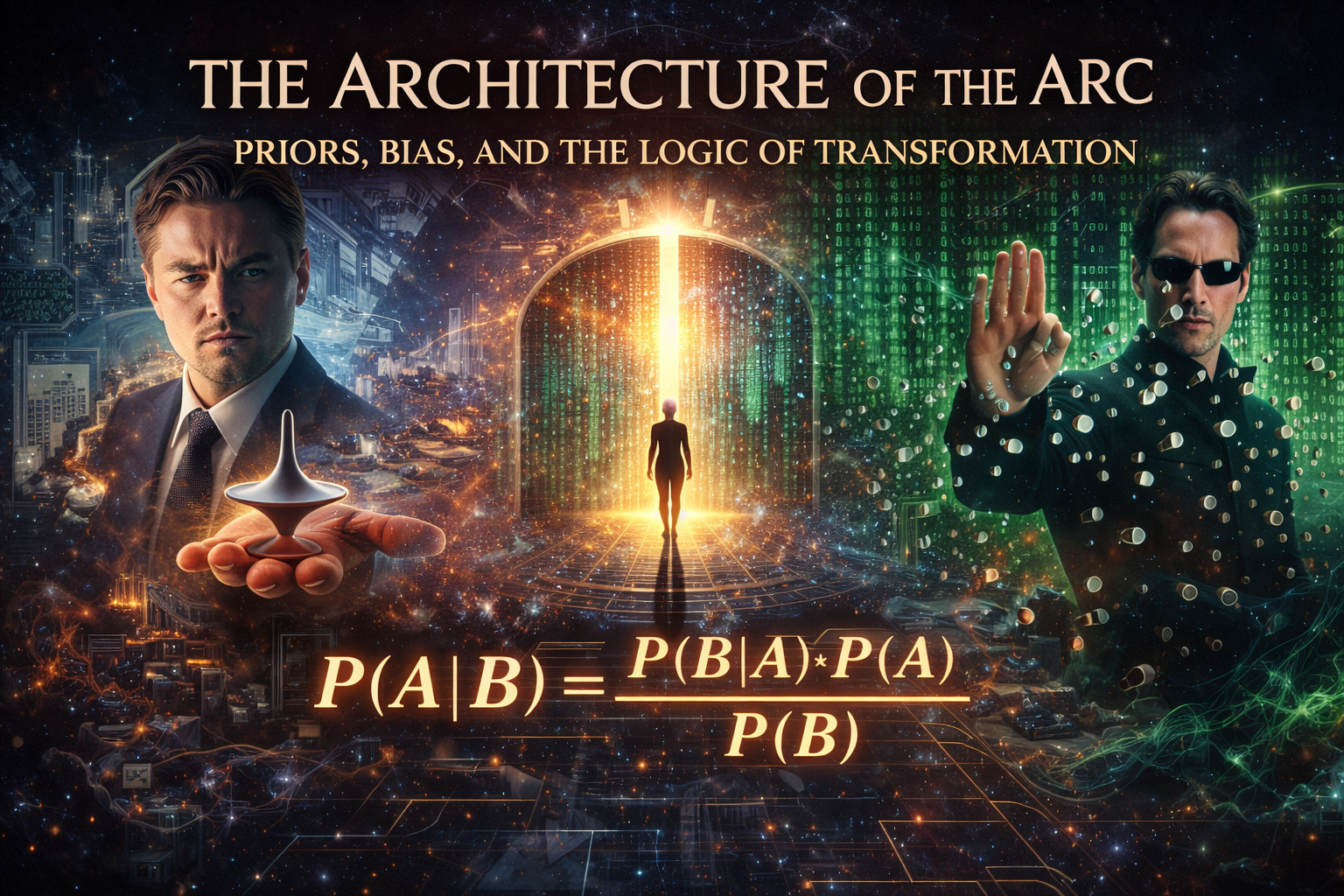
A character arc is reframed here as a Bayesian process: the soul does not “change” sentimentally, it updates probabilistically. Drawing on Bayes’ Theorem, the text interprets belief as a prior—an inherited or constructed map of the world—continuously recalibrated by evidence unless distorted by bias. Psychological growth becomes an act of epistemic courage: the willingness to let new data destabilize inherited archetypes, echoing the depth psychology of Carl Jung, where archetypes function as primordial priors shaping perception. Cinema becomes the laboratory of this logic: in Inception, belief is surgically rewritten by manipulating likelihoods until identity itself is recalculated; in The Matrix, a false prior is shattered by overwhelming evidence, culminating in epistemic mastery. Across philosophy, psychology, and film, transformation emerges not as mythic ornament but as mathematical necessity—the arc as the precise architecture of belief revised under pressure.
The Architecture of the Arc: Priors, Bias, and the Logic of Transformation
Leitmotiv: A character arc is not merely a change in behavior, but a mathematical update of the soul.
The Architecture of Belief: Understanding Bayesian Epistemology
In the realm of philosophy, we often treat knowledge as a binary: we either know something or we don’t. However, Bayesian Epistemology offers a more nuanced, fluid perspective. It treats belief as a matter of degree—a probability held between 0 and 1. At its heart lies the Prior, the initial internal map we carry based on past experiences and ingrained assumptions.
When we encounter new information, we don't just add it to a pile; we perform a mental calculation. We weigh the new evidence against our Priors to produce a Posterior—our updated, more refined belief. This process is the gold standard for rational thinking.
The friction in this system arises from Bias. While a prior is a necessary starting point, a bias is a structural distortion that prevents the update from happening. It is the "weight" on the scale that makes us ignore evidence that contradicts our comfort zone. To think like a Bayesian is to be in a constant state of "becoming," perpetually willing to let the world correct your internal map.
The Mathematical Engine: Bayes’ Theorem
At the center of this philosophy is a single, elegant equation that governs how a rational agent should adjust their level of confidence in a belief. Bayes’ Theorem provides the formal logic for the "update."
In this formula,
Exkursus: The Primordial Prior—Jungian Archetypes as Evolutionary Templates
There is a profound common ground between Bayesian Epistemology and Carl Jung’s Theory of Archetypes: Archetypes function as our "Biological Priors." In Jungian psychology, these are not learned from personal experience but are inherited, universal patterns residing in the collective unconscious. From a Bayesian perspective, archetypes are the high-probability "templates" that evolution has hard-coded into our cognition before we even encounter the world.
While Bayesian Epistemology focuses on how we update beliefs through new data, Jungian theory describes the rigid, ancient "starting points"—such as the Mother, the Shadow, or the Hero—that dictate how we filter that data in the first place. Archetypes act as the ultimate cognitive bias; they are the "Pre-set Priors" that compel us to project a mentor onto a teacher or a monster into the dark, often regardless of objective evidence. Consequently, true psychological growth—or Individuation—can be viewed as the lifelong process of updating these inherited, mythic Priors with the actual, granular data of our individual lives.
The Hero’s Update: Bayesian Logic in Cinema
In screenwriting and filmmaking, we often talk about the "Character Arc," but we rarely define the mechanics of how that change occurs. If we view a film through a Bayesian lens, the story becomes a series of high-stakes "data points" designed to break a character’s initial biases.
-
The Ordinary World as a Static Prior: At the start of the Hero’s Journey, the protagonist is trapped by a Bias that keeps them safe but stagnant.
-
The Call to Adventure as an Anomalous Data Point: The Inciting Incident functions as a "signal" amidst the "noise." The Refusal of the Call is a manifestation of cognitive dissonance—an attempt to preserve the internal math by dismissing the new evidence.
-
The Special World as a Bayesian Crucible: Once the threshold is crossed, every trial provides a new "Likelihood" that the old way of thinking is wrong.
-
The Resurrection: This is the final proof of transformation. The Hero acts not on who they were (the Prior), but on who they have become (the Posterior).
The Heist of the Mind: A Bayesian Analysis of Inception
Christopher Nolan’s Inception is a masterclass in this logic. To perform "Inception," one must bypass a subject's Bias to manually install a new Prior.
-
Fischer’s Prior: "My father thinks I am a disappointment."
-
The Strategy: Cobb’s team doesn't argue; they provide a sequence of dream-layer evidence that shifts the Likelihood. If his father’s right-hand man is a traitor, then the "disappointment" might actually be a hidden form of protection.
-
The Posterior: When Fischer finds the pinwheel in the safe, his math flips. His new Prior—"My father wanted me to be my own man"—reconstructs his entire identity.
The Digital Update: Solving for Truth in The Matrix
If Inception is about planting a belief, The Matrix is about the violent destruction of a false one.
-
The False Prior: Neo believes the 20th-century simulation is reality (
). -
The Likelihood Provider: Morpheus shows Neo that "glitches" (the splinter in the mind) are highly probable in a simulation but impossible in reality.
-
The One: Neo’s training is a series of rapid updates to his physical biases ("There is no spoon"). The climax is the moment Neo reaches a Posterior probability of 1.0. He no longer "believes" he can stop bullets; he knows the code, rendering the old physical priors of his mind obsolete.
The Architecture of the Arc: (long form)
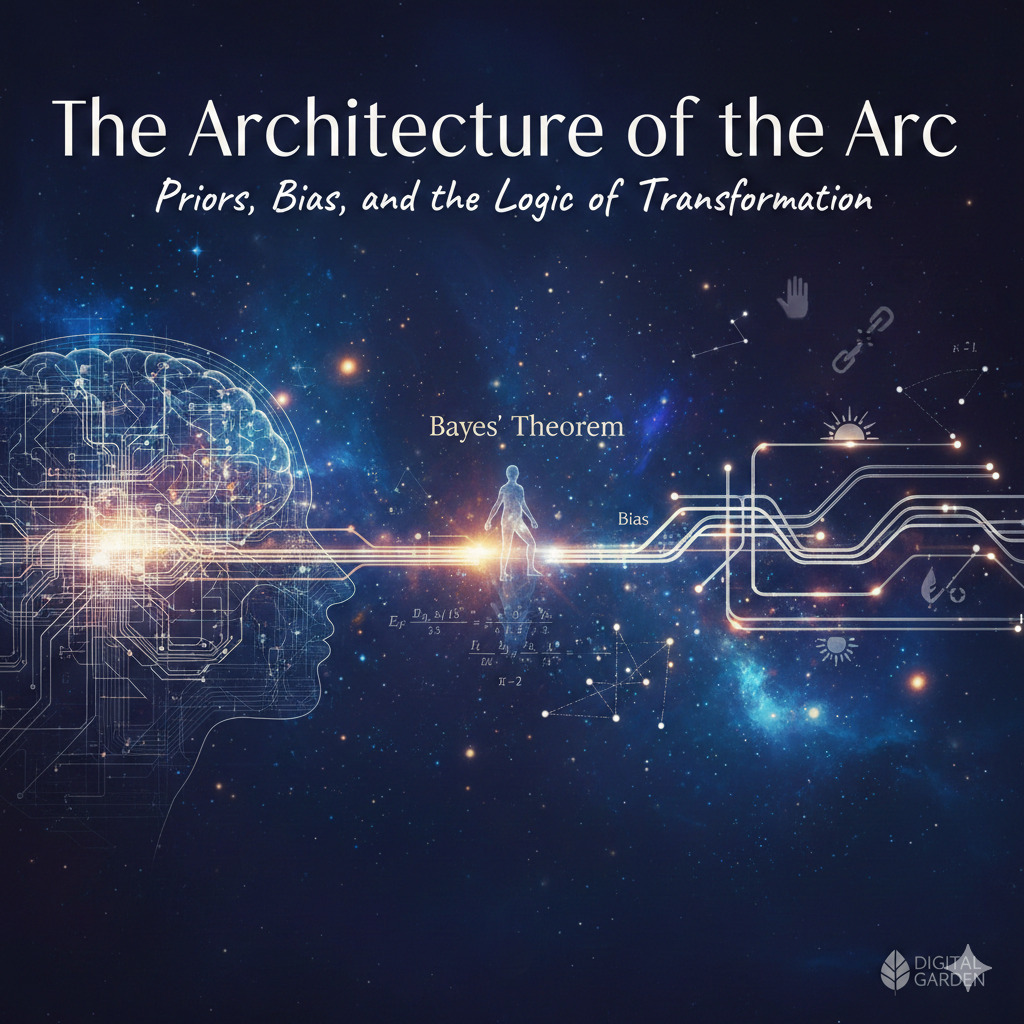
Priors, Bias, and the Logic of Transformation
The Architecture of Belief: Understanding Bayesian Epistemology
In the realm of philosophy, we often treat knowledge as a binary: we either know something or we don’t. However, Bayesian Epistemology offers a more nuanced, fluid perspective. It treats belief as a matter of degree—a probability held between 0 and 1. At its heart lies the "Prior," the initial internal map we carry based on past experiences and ingrained assumptions.
When we encounter new information, we don't just add it to a pile; we perform a mental calculation. We weigh the new evidence against our Priors to produce a Posterior—our updated, more refined belief. This process is the gold standard for rational thinking.
The friction in this system arises from Bias. While a prior is a necessary starting point, a bias is a structural distortion that prevents the update from happening. It is the "weight" on the scale that makes us ignore evidence that contradicts our comfort zone. To think like a Bayesian is to be in a constant state of "becoming," perpetually willing to let the world correct your internal map.
The Hero’s Update: Bayesian Logic in Cinema
In screenwriting and filmmaking, we often talk about the "Character Arc," but we rarely define the mechanics of how that change occurs. If we view a film through a Bayesian lens, the story becomes a series of high-stakes "data points" designed to break a character’s initial biases.
The Ordinary World as a Static Prior
At the start of the Hero’s Journey, the protagonist lives in the "Ordinary World." This is more than just a physical location; it is a rigid set of Priors. Whether it is a detective who believes everyone is corrupt or a hero who believes they are small and insignificant, these characters are trapped by a Bias that keeps them safe but stagnant.
The Call to Adventure: The Anomalous Data Point
The Inciting Incident functions as the first piece of evidence that the hero’s prior is insufficient. It is a "signal" amidst the "noise" of their daily life. The Refusal of the Call is essentially a manifestation of cognitive dissonance—the hero’s attempt to preserve their internal math by dismissing the new evidence as a fluke or an impossibility.
The Special World: The Bayesian Crucible
Once the hero crosses the threshold, they enter a "Special World" where their old Priors no longer predict reality. The journey through Tests, Allies, and Enemies acts as a sequence of Bayesian updates.
- Each trial provides a new "Likelihood" that their old way of thinking is wrong.
- The Ordeal or "Midpoint" serves as the most powerful piece of evidence possible, forcing the hero to choose between their comfortable Bias and the undeniable truth of their situation.
- The Resurrection is the final proof of the Hero's transformation. They act not on who they were (the Prior), but on who they have become (the Posterior).
The Satisfying Conclusion: Earning the Update
A story feels "earned" when the audience can track the mathematical necessity of the hero’s change. If a character changes too quickly, the "Prior" felt weak; if they don't change despite overwhelming evidence, the character feels stubborn or poorly written. The most resonance is found when the hero undergoes a "Black Swan" event—an improbable, life-altering moment that shatters their bias and forces a total recalibration of their world.
The Primordial Prior: Jungian Archetypes as Evolutionary Bayesian Templates
There is a profound common ground between Bayesian Epistemology and Carl Jung’s Theory of Archetypes: Archetypes function as our "Biological Priors." In Jungian psychology, these are not learned from personal experience but are inherited, universal patterns residing in the collective unconscious. From a Bayesian perspective, archetypes are the high-probability "templates" that evolution has hard-coded into our cognition before we even encounter the world. While Bayesian Epistemology focuses on how we update beliefs through new data, Jungian theory describes the rigid, ancient "starting points"—such as the Mother, the Shadow, or the Hero—that dictate how we filter that data in the first place. Archetypes act as the ultimate cognitive bias; they are the "Pre-set Priors" that compel us to project a mentor onto a teacher or a monster into the dark, often regardless of objective evidence. Consequently, true psychological growth—or Individuation—can be viewed as the lifelong process of updating these inherited, mythic Priors with the actual, granular data of our individual lives.
The Heist of the Mind: A Bayesian Analysis of Inception
Leitmotiv: To change a man’s mind, you must not simply present new data; you must plant a new prior.
Christopher Nolan’s Inception is often viewed as a complex puzzle of dream layers, but at its core, it is a masterclass in Bayesian Epistemology. The film’s central conceit—Inception—is the act of bypassing a subject's Bias to manually install a new Prior.
1. The Subject: Robert Fischer’s Rigid Prior
The target of the heist, Robert Fischer, is defined by a singular, painful belief: "My father was disappointed in me and thinks I am a weak successor."
-
The Prior (
): "I am an unloved disappointment." (95% confidence). -
The Bias: Fischer views every action of his father through this lens. When his father’s last word is "Disappointed," Fischer interprets it as a confirmation of his inadequacy, rather than a regret about their relationship. He filters out any "noise" that suggests his father loved him.
2. The Strategy: Manipulating the Likelihood (
Cobb and his team realize they cannot simply tell Fischer "your father loved you." Fischer’s bias would weight that evidence as zero. Instead, they must create a series of Likelihoods that force Fischer to update his own math.
-
The Dream Layers as Data Points: In the first layers, they introduce the idea that his father’s right-hand man (Browning) is conspiring against him. This shifts the "Evidence" (
). -
The Bayesian Update: If Browning is the enemy, then perhaps the "disappointment" Fischer felt from his father was actually a result of Browning's interference. The probability of
(being unloved) begins to drop.
3. The Climax: The Posterior Realization
In the final vault (the deepest layer), Fischer encounters his dying father. He finds the pinwheel—a symbol of a childhood memory.
- The Evidence (
): The pinwheel in the safe. - The Posterior (
): Fischer sees the pinwheel and "updates" his belief. He realizes his father wasn't disappointed in him, but disappointed that Robert tried to be him. - The Result: The update is so profound that it leads to the immediate dissolution of his father’s empire. The "mathematical" change in his belief dictates his real-world actions.
4. The Architect: Dom Cobb’s Unstable Prior
While the team performs inception on Fischer, the audience witnesses Cobb struggling with his own Bayesian failure.
- Cobb’s Prior: "I am responsible for my wife Mal’s death."
- The Bias: Cobb is haunted by a "Ghost" that makes him see Mal in every dream. He cannot update his belief that she is gone because his guilt (a massive psychological bias) keeps her alive in his subconscious.
- The Update: Cobb’s arc concludes when he finally accepts that the Mal in his dreams is just a projection—a piece of "noise" rather than "signal." He assigns her a
probability of being the real Mal and finally lets go.
The Totem: Checking the Validity of Reality
The "Totem" is the ultimate Bayesian tool. It is a physical test designed to provide a 100% reliable data point. If the top falls, the probability of being in the "Real World" is 1. If it spins forever, the probability is 0.
The film’s famous ending—where the top wobbles but the screen cuts to black—is Nolan’s way of asking the audience: "Given the evidence you’ve seen, what is your Posterior probability that Cobb is home?"
The Digital Update: Solving for Truth in The Matrix
#MATRIX #Morpheus #MATRIX/RedPill
Leitmotiv: Red pills are not just choices; they are massive injections of high-probability data into a corrupted prior.
If Inception is about planting a belief, The Matrix is about the violent destruction of a false one. The film serves as a perfect allegory for Epistemic Friction—the painful process of a mind being forced to update when its internal model of reality (
1. The Ordinary World: The 100% False Prior
At the start of the film, Thomas Anderson exists in a state of maximum bias. His "Prior" is the world as he sees it: 1999, cubicles, and coffee.
- The Prior (
): "Reality is a physical, 20th-century world." (Confidence: 99.9%). - The Cognitive Bias: When Neo encounters "glitches" (the "splinter in the mind"), he initially treats them as noise. He tries to rationalize the agents and the impossible physics as a dream or a mental breakdown. He is protecting his prior from evidence that would shatter his sanity.
2. Morpheus: The Likelihood Provider
Morpheus acts as the "Bayesian Teacher." He doesn't just tell Neo the truth; he provides the Likelihood (
- The Red Pill (
): This is the ultimate "High-Probability" data point. It is a trace program that disrupts Neo's connection. - The Update: Once Neo "wakes up" in the pod, his old Prior is mathematically obliterated. The evidence of his own eyes (the machines, the fields of humans) is so strong that the probability of his old life being real drops to zero.
3. The Formula in Action: "I Know Kung Fu"
The training sequences on the Nebuchadnezzar are a series of rapid Bayesian updates.
- The Problem: Neo still carries the "Residual Self-Image"—a bias that says his body has physical limits (gravity, speed, oxygen).
- The Update: Morpheus challenges him in the spar: "You think that's air you're breathing now?" He is forcing Neo to update the Likelihood of his physical constraints.
- The Posterior: Neo’s "Posterior" belief becomes: "This world is code, and code can be rewritten." His confidence in the rules of the Matrix begins to shift from 100% (Solid) to 0% (Fluid).
4. The Climax: The Zero-Point Prior
The moment Neo becomes "The One" is the moment he reaches a Posterior probability of 1.0.
When the Agents shoot Neo in the hallway, his old "Prior" (death is final) is tested one last time. Through Trinity’s voice (new data) and his own realization, he updates his belief completely. He stops seeing the Agents as "men" (noise) and starts seeing them as "lines of green code" (signal).
Bayesian Result: Because he no longer "believes" in the bullets (he has updated his prior to match the digital reality), the bullets lose their power to harm him. He has achieved Epistemic Mastery.
Summary of the Matrix Update
| Stage | Bayesian Variable | Narrative Equivalent |
|---|---|---|
| Blue Pill Life | Prior ( |
The belief that the simulation is reality. |
| The Splinter | Evidence ( |
Glitches, the white rabbit, meeting Morpheus. |
| The Training | **Likelihood ($P(B | A)$)** |
| The One | **Posterior ($P(A | B)$)** |
References
- [ ]